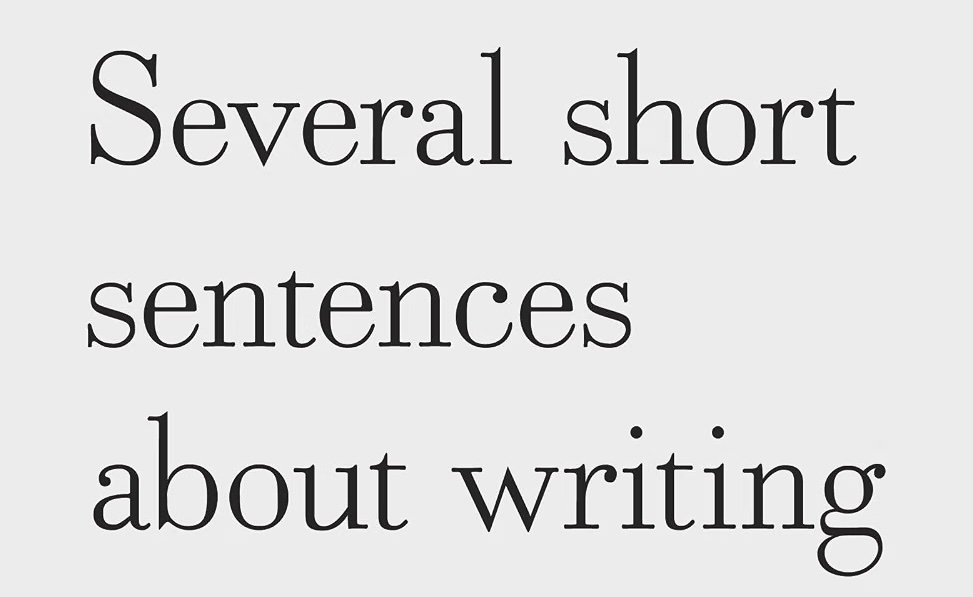
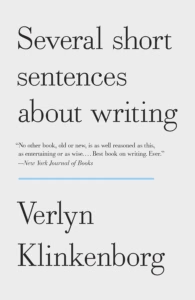
There are a handful of boos about writing that I would recommend to any writer or aspiring writer (On Writing, On Writing Well, On Writing (and Writers), Elements of Style, Do the Work, Eats, Shoots & Leaves, etc.) and I am regularly looking for more. Frankly they are hard to find. There is much redundancy, derivation, and just plain hackery out there. There are also plenty of great writers whose thoughts on writing are so pompous and esoteric as to be functionally useless (see: Ernest Hemingway). So when I find a book, albeit an imperfect one, that genuinely offers genuinely helpful insights, inspiration, and instruction I latch on. Several Short Sentences About Writing by Verlyn Klinkenborg is just such a book. Klinkenborg isn’t a particularly well-known name as an author but rather a widely respected writer and editor among students of the craft, not unlike William Zinsser. His book is not a manual, but more like a series of reflections. Reading it is a bit like fishing–periods of pleasant boredom with periodic thrills and memories made. The good parts are brilliant and so helpful. The other parts can be quickly trolled through. For a writer, this book should enter your stable of encouragements and helps. I have compiled thirty of my favorite quotes for you.
-
There are innumerable ways to write badly. The usual way is making sentences that don’t say what you think they do. . . Knowing what you’re trying to say is always important. But knowing what you’ve actually said is crucial. – p. 4
-
The longer the sentence, the less it’s able to imply, And writing by implication should be one of your goals. – p.12
-
No sentence can afford to be merely transitional. If you’ve written clearly—and you know what you’ve said and implied as surely as you know what you haven’t said—the reader will never get lost reading your prose Or have trouble following you without transitions. A reader is likelier to get lost cutting his way through The jungle of transitions than crossing the gap of a well-made ellipsis. – p.25
-
Writing isn’t a conveyer belt bearing the reader to “the point” at the end of the piece, where the meaning will be revealed. Good writing is significant everywhere, delightful everywhere. – p.27
-
A crowded sentence betrays the writer’s worry that the reader won’t follow the prose if parted by a period. – p.29
-
You were taught the perfect insincerity of the writing exercise, asked to write pieces in which you didn’t and couldn’t believe. You learned a strange ventriloquism, saying things you were implicitly being asked to say, knowing that no one was really listening. You were being taught to write as part of a transaction that had almost nothing to do with real communication, Learning to treat the making of sentences as busywork, A groping for words, an act of drudgery, a way of dressing up your meaning or your argument with almost no attention to the character of the words or sentences you were using, unless you were trying to imitate the stiff and impersonal manner of “formal” prose. – p.30-31
-
You don’t even notice what you notice, because nothing in your education has taught you that what you notice is important. – p. 36
-
Start by learning to recognize what interests you. Most people have been taught that what they notice doesn’t matter. So they never learn how to notice, Not even what interests them. Or they assume that the world has been completely pre-noticed, already sifted and sorted and categorized. – p.38
-
There’s always an urge among writers To turn fleeting observations and momentary glimpses Into metaphors and “material” as quickly as possible, as if every perception ended in a trope, as if the writer were a dynamo turning the world into words. The goal is the opposite: to get your words, your phrases, As close as you can to the solidity, the materiality of the world you’re noticing. – p.40
-
You’ll never run out of noticings. And there are more than enough sentences to let a few go. – p.41
-
And yet you’ve been taught to make sentences In which inert verbs act abstractly upon faceless nouns, to write on a theoretical basis, which deprives the world of its content, and to use passive constructions, which absolve everyone of responsibility. – p. 43
-
A true metaphor is a swift and violent twisting of language, a renaming of the already named. It’s meant to expire in a sudden flash of light and to reveal—in that burst of illumination—a correspondence that must be literally accurate. Any give in the metaphor, any indeterminacy, and it becomes a cloud of smoke, not a flash of light. Like any rhetorical device, the less you use it, the more effective it is. – p.44
-
A cliché is dead matter. It causes gangrene in the prose around it, and sooner or later it eats your brain. You can’t fix a cliché by using it ironically. You can’t make it less gangrenous by appearing to “quote” it or invert it or joke about it. A cliché isn’t just a familiar, overused saying. It’s the debris of someone else’s thinking, any group of words that seem to cluster together “naturally” and enlist in your sentence. The only thing to do with a cliché is send it to the sports page or the speechwriters, where it will live forever. – p.45
-
When the work is really complete, the writer knows how each sentence got that way, what choices were made. You become not only a living concordance of your work, able to say where almost any word appears. – p.48
-
The fundamental act of revision is literally becoming conscious of the sentence, seeing it for what it is, word for word, as a shape, and in relation to all the other sentences in the piece. – p.49
-
How well you read aloud reveals how well you understand the syntax of a sentence. – p.52
-
Variation is the life of prose, in length and in structure. – p.55
-
The point of learning the fundamental language of grammar and syntax isn’t correctness or obeying the rules. It’s keeping the rules from obtruding themselves upon the reader because you’ve ignored them. – p.65
-
Flow is something the reader experiences, not the writer. . . The idea of writer’s block, in its ordinary sense, exists largely because of the notion that writing should flow. But if you accept that writing is hard work, and that’s what it feels like while you’re writing, then everything is just as it should be. Your labor isn’t a sign of defeat. It’s a sign of engagement. The difference is all in your mind, but what a difference. p.67-68
-
Humans have a language instinct but not necessarily a writing instinct. The difference between talking and writing is the difference between breathing and singing well. It takes years of work to write well, and only part of that is learning to type. – p.72
-
The most damaging and obstructive cluster of ideas you face as a writer are nearly all related to the idea of “flow.” Like “genius.” And “sincerity.” And “inspiration.” Distrust these words. They stand for cherished myths, but myths nonetheless. “Inspiration” is what gets you to the keyboard, and that’s where it leaves you. – p.78
-
Anything you think you need in order to write—or be “inspired” to write or “get in the mood” to write becomes a prohibition when it’s lacking: learn to write anywhere, at any time, in any conditions, with anything, starting from nowhere. All you really need is your head, the one indispensable requirement. – p.80
-
“Style” shouldn’t linger in your awareness. You don’t need to think about style.It’s as likely to appear in the character of your thinking, The shape of your ideas, your sense of humor or irony, as it is in any “stylistic” markers in the prose itself. . . Pursue clarity instead. In the pursuit of clarity, style reveals itself. Your clarity will differ from anyone else’s without your intending to make it differ. – p.85
-
Think of composition and revision as the same thing, different versions of thinking, philosophically indistinguishable. – p.88
-
Finding flaws is how you learn to make better sentences. Enjoy it. You can’t prevent yourself from repeating a mistake you haven’t noticed. – p.90
-
You want to begin the piece, not introduce it, which is the difference between a first sentence already moving at speed and a first sentence that wants to generalize while clearing its throat. – p.102
-
No subject is so good that it can redeem indifferent writing. But good writing can make almost any subject interesting. – p.129
-
The ordinary reader-the ordinary audience is a barren conceit. It guarantees a shared mediocrity. Don’t preconceive the reader’s limitations. They’ll become your own. . . imagine a reader you can trust. – p.139
-
Why would you try to overawe a reader you can trust? The reader you can trust is a reader predisposed to trust you. In that reciprocity lies the joy of writing and reading. You can’t trust the reader without also trusting yourself. . .The trustworthy reader learns the writer’s habitude and how to move with it. You converse, in a sense, with the voice on the other side of the ink. – p.140-141
-
You’re not responsible for your readers’ ignorance, and they’re not responsible for your erudition. Know what you want to know, learn what you want to learn, use what you want to use, without worrying whether you’re wandering out of the reader’s depth. – p.145